
Some of the animals I’ve been stalking spending time around this spring.
Galleries
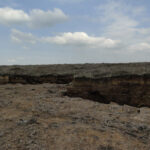


When I was a kid, to be called a “bogman” was an insult. It meant you were stupid, uncultured, uncivilised. Never mind that many of Ireland’s greatest poets and painters were inspired by bogland, by its history, its beauty and its mysteries. I’d never really seen the attraction myself, not having grown up near it and catching only glimpses of flat, dark earth on long car journeys. If it wasn’t boring it was mildly menacing, with stories of lost souls drowned in bogholes, led astray by a will-o’-the-wisp, or human sacrifices buried in the bog by druids or republicans.
So I went to the bog to see what I was missing. And it really is beautiful. It was lonely and windswept, but warm and soft underfoot, with an incredible variety of bizarre, alien plant-life. Pieces of a fallen branch eroded by acid looked like twists of fabric, feathered and fraying. I almost lost my foot a couple of times to treacherous ground, pitch black water gliding into deep footprints. I half hoped to find a body. What I did find was a thin tree, creaking in annoyance as a wooden pallet left leaning against its trunk gradually wore away the bark. I pulled the pallet down, I saved the tree. I half expected someone to grant me wishes.
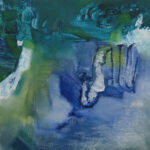
2 of 2.
Oil on MDF, 12×12"

1 of 2
Oil on MDF, 12×12"

A work in progress – oil & oil pastel on canvas, 30×24".
This is a small waterfall I discovered amidst the woods in the Slieve Bloom mountains, in Co. Offaly. I don’t know how successful my efforts at landscape are. I think a painting should say more than “here’s this thing I saw.” But I don’t know if these do. I’m finding it hard to articulate what it feels like to be here, alive in the world, and looking at Stuff. It feels good.
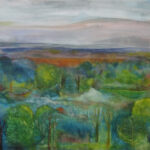
View towards Slieve Bloom mountains.
Oil on canvas, approx 20×17.5"

I’ve temporarily relocated to a new studio even further from civilization in an attempt to get to grips with landscape. I’m trying to work out what landscape can do or express that the figure can’t.
Most of my favourite landscapes were painted by artists (like Klimt, Schiele, etc.) who normally dealt with the figure. COINCIDENCE? PROBABLY. I suspect I just like the artist’s style, regardless of subject matter. But at the very least, I want to find out what aspects of my own style carry over to landscape, or don’t, so I get a clearer picture of what my own style actually is. I should know this by now.
In other the-penny-drops news, I have been messing around with a violin and am only just getting a handle on the idea of musical keys and the parameters that can define or at least give colour to a whole genre. Like why a blues song sounds like a blues song, for example.
A clunky metaphor. I’m trying to find out what key I play best in.
Painting in the photo is a work in progress, 1×1.5m, oil on linen.
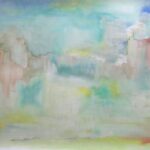
This is just a scroll of paper taped to the wall that I add to now and again when other paintings aren’t going well. It’s like knitting or chewing the cud. It passes the time.
I suppose it’s abstract, but that seems the wrong word by now because I know its forms so well that revisiting it feels like walking down a familiar street. It seems obvious where everything is in relation to each other. Abstraction usually feels vague, that’s its appeal; shapes morph and colours bleed and planes shift. This one feels more like a lovely, horrible, old misshapen teddybear: to anyone else, it’s probably hard to tell what it’s meant to be, but I’ve spent so much time with it I think it’s perfectly clear. It’s meant to be what it is.
Oil on paper, 21×42"
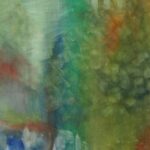
I’m learning to use oil more like watercolour. The key is lots and lots of turpentine. So much turpentine that the fumes make you slightly headachey and you wonder if the cat glaring in the window is a hallucination but it isn’t so you feed it some ham.
Oil on canvas 12X16"

Adventures in watercolour print-making.
Mostly 8×8" approx.